The Ancient Styles of Muay and the Formation of Muay Thai: Korat, Lopburi, Chaiya, Tha Sao, and the Forgotten Lineages of Siam
Ancient Styles of Muay: Korat, Lopburi, Chaiya, Tha Sao, and the Origins of Muay Thai
Introduction: Before Muay Thai, There Were Many Muay
When we talk about Muay Thai today, we typically envision a relatively standardized sport: a ring, gloves, rounds, a referee, weight classes, rules, and a technical language shared by fighters worldwide.
However, this system is relatively recent.
For much of the history of ancient Siam, muay (มวย) was a much broader term. It referred to body combat practices that could be linked to community defense, military training, noble protection, festivities, temples, and local competitions. The Thailand Foundation itself notes that different regions developed their own techniques, which were later grouped under the modern category of Muay Boran (มวยโบราณ).
It is in this context that the names that became famous in the historiography of Muay emerge: Muay Korat, Muay Lopburi, Muay Chaiya, and Muay Tha Sao.
But there is a crucial caveat.
We should not imagine that four perfectly organized styles existed since ancient times, each with a closed, uniform, and independent curriculum. The available documentation is much more fragmented. The classification of the four major styles is a modern way to organize regional traditions that had varying degrees of continuity.
Historian Peter Vail has pointed out this very process: Muay was progressively transformed into a national symbol, and Thai institutions began to organize and systematize its history as cultural heritage.
This does not mean that the traditions are false. It means we need to distinguish the historical existence of the practices from the way they were later classified.
The Map of Ancient Muay in Siam
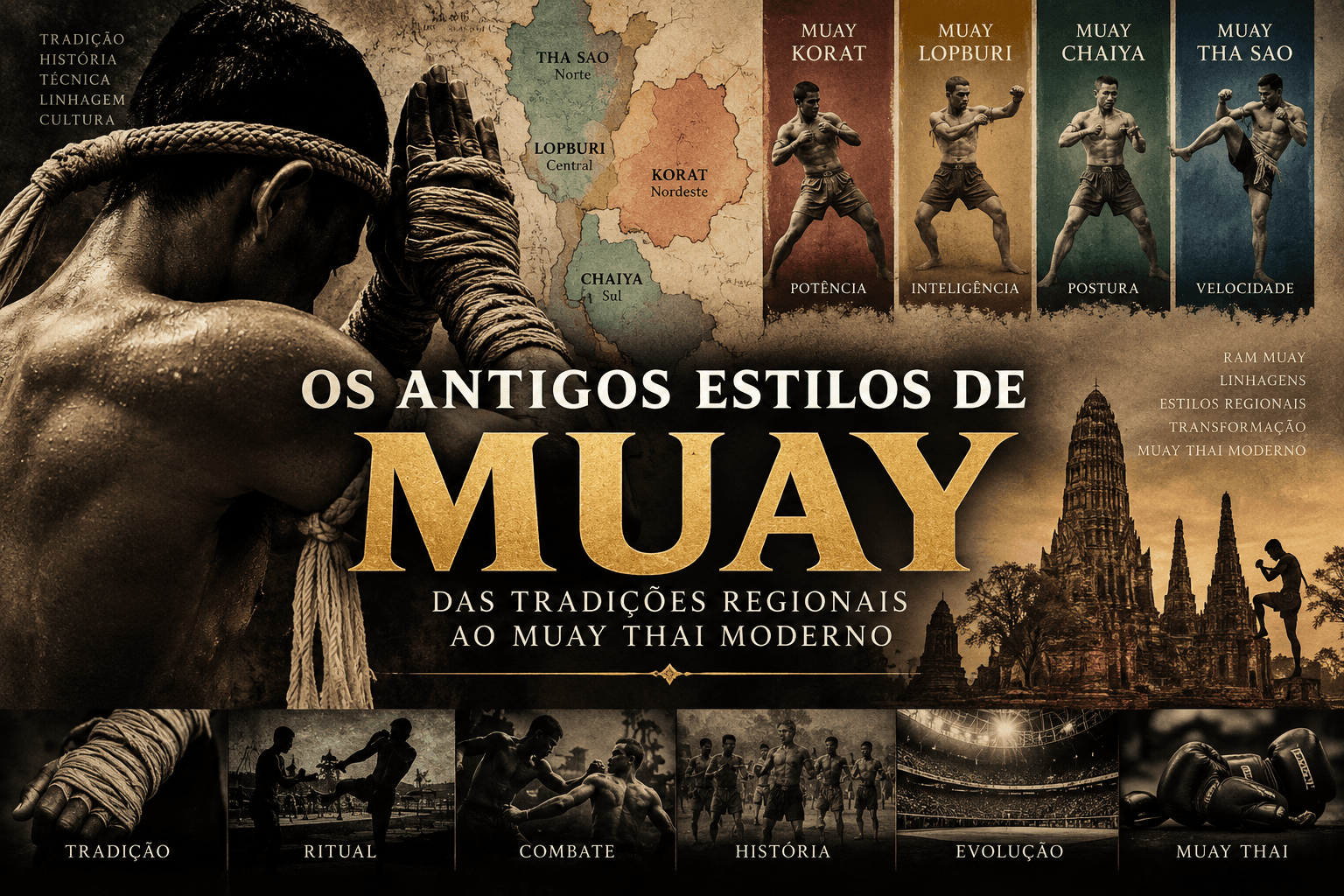
The most well-known classification includes four major regional traditions:
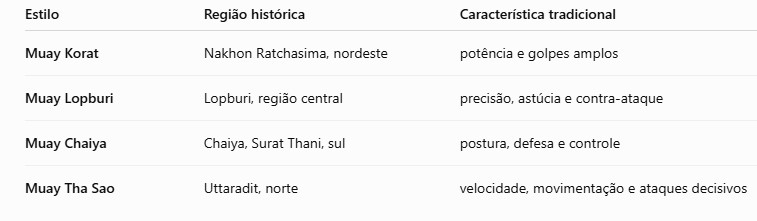
The Department of Physical Education in Thailand currently works with a classification of five styles, adding Muay Pala Sueksa (มวยพลศึกษา), a more modern tradition of institutional and educational nature.
This is important because it shows that the well-known model of the "four styles" does not necessarily represent the entire historical universe of Muay.
Muay Korat: The Muay of Power


In the northeast of ancient Siam, the region of Nakhon Ratchasima, known as Korat, developed one of the most recognized traditions.
Muay Korat is associated with strength, pressure, and wide strikes. Its most famous technique is:
หมัดเหวี่ยงควาย — Mat Wiang Khwai
often translated as "buffalo punch".
The Thailand Foundation describes Muay Korat as a tradition characterized by powerful strikes and wide attacks, especially at mid-range.
Regional documentation also preserves an important sequence of fighters associated with the tradition, including Daeng Thaiprasert, Yang Hanthale, Thap Chamko, Tuu Thaiprasert, Phuan Kanjanakas, and others.
Daeng is particularly significant because his history allows us to move beyond purely legendary territory. He is associated with Phra Hem Samahan, an authority in Korat, and later with organized competitions at the court.
This demonstrates something fundamental: the regional identity was not simply a later invention. There were fighters, masters, and transmission networks associated with specific regions.
What is more difficult to prove is whether these networks already constituted, centuries earlier, a perfectly defined "Korat style" as we understand it today.
Muay Lopburi: Technique, Intelligence, and Counterattack


In the central region, Lopburi became associated with another quality: intelligence in combat.
The traditional formula that summarizes the styles is often presented as:
Korat has the heavy strike; Lopburi has the intelligence; Chaiya has the posture; Tha Sao has the speed.
In the case of Lopburi, the traditional emphasis is on the ability to deceive, maneuver, provoke the attack, and respond to the opponent's movement.
Thai institutional documentation describes the style as based on quick combinations of attack and defense, using straight strikes and movements intended to distract the opponent.
The style is also associated with the term:
มวยเกี้ยว — Muay Kiao
related to the idea of deceiving or distracting the opponent.
A key figure in this tradition is:
กลึง โตสะอาด — Klueng Tosa-at
who received the title:
หมื่นมือแม่นหมัด — Muen Mue Maen Mat
The existence of these fighters and their titles is particularly important because it demonstrates how the Siamese state began to recognize certain combatants as representatives of their regions.
Muay Chaiya: The Importance of Posture


If Korat is known for power and Lopburi for intelligence, Chaiya became synonymous with posture and body structure.
Originating from Chaiya, in present-day Surat Thani, the style maintains a more compact, defensive position, ready to counterattack.
The Thailand Foundation particularly highlights:
specialized postures;
movement;
control;
locks;
throws;
footwork.
A technique traditionally associated with Chaiya is:
ย่างสามขุม — Yang Sam Khum
or "steps of the three domains".
It is precisely here that our research on Ram Muay postures begins to get more interesting.
Ram Muay and the Postures: Dance, Combat, or Technical Memory?
The Ram Muay (รำมวย) is often presented to modern audiences as a ritual dance performed before a fight.
This is correct but incomplete.
The Ram Muay can simultaneously carry:
homage to the master → ritual → psychological preparation → lineage identification → body memory.
The Thailand Foundation records that each lineage has its own movements transmitted from master to disciple and that the Wai Kru/Ram Muay can also serve as a way to identify the fighter's lineage.
This is fundamental to understanding the postures.
A specific posture of the Ram Muay should not automatically be interpreted as:
"this was a fighting position used exactly like this in the 18th century."
In many cases, it is safer to understand it as:
a ritualized representation of a particular body tradition.
The movement may preserve elements of:
guard;
movement;
balance;
strike preparation;
homage;
cosmology;
imitation of characters;
master's memory.
Therefore, Ram Muay and combat technique intersect, but they are not the same thing.
The posture of Chaiya and the Ram Muay
Chaiya offers one of the best examples of this intersection.
The tradition is known for its emphasis on form, not just on the execution of strikes. The Thai institutional description places "form" as a central characteristic of the style.
This means that:
foot position → arm position → weight distribution → ritual movement
can function as a kind of body language of the school.
However, we should not turn every movement of the Ram Muay Chaiya into a literal combat technique.
What we can safely assert is that the lineage transmits its own sets of ritualized movements, and that these movements help preserve the identity of the school.
Muay Tha Sao: Speed, Mobility, and the Tradition of Phraya Phichai


In the north, we find Muay Tha Sao, associated with the region of Uttaradit.
The tradition is summarized by the expression:
ไวท่าเสา — "Tha Sao is fast".
The Department of Physical Education characterizes Tha Sao by speed and quick attacks; the Thailand Foundation highlights its wide leg strikes and the pursuit of quickly hitting vulnerable points on the body.
A technique traditionally associated with the style is:
ไต่เมฆ — Tai Mek
or "climbing through the clouds".
The Tha Sao tradition is also closely linked to the memory of:
พระยาพิชัยดาบหัก — Phraya Phichai Daap Hak
the famous Phraya Phichai of the Broken Sword.
His figure belongs to the history of the Thonburi period and the military formation of the kingdom of Taksin. The association of Phraya Phichai with Tha Sao is preserved by Thai historical tradition.
Here, a characteristic that differentiates Tha Sao clearly appears:
Muay + warrior training + weapons + unarmed combat.
This reminds us that the ancient traditions of Muay cannot be studied in isolation from other martial arts of Siam.
And Where Does the Ram Muay Fit into These Styles?
This is one of the most interesting questions—and also one that requires more care.
The Wai Kru is a widely shared tradition.
The Ram Muay, however, presents variations among lineages.
The Thailand Foundation explicitly states that each lineage has its own movements transmitted by masters. The ritual also serves to demonstrate respect and identify the fighter's technical origin.
This allows us to think of the Ram Muay as a kind of body archive.
A manuscript records words.
A Muay lineage could record knowledge through the body:
posture → step → gesture → sequence → repetition → disciple.
And this explains why certain elements survived even when the sporting rules changed.
The Characters of the Ram Muay
Another aspect that deserves attention is the presence of characters and symbolic images.
Among modern traditions, we find movements associated with figures such as:
Hanuman;
characters from the Ramakien;
animals;
warriors;
hunters;
mythological figures.
But here again, we need to establish a boundary.
It is possible to document the presence of Hanuman and other characters in the modern ritual and technical tradition.
This does not mean we can assert that a specific sequence was executed exactly the same way by a warrior from Ayutthaya.
Historical documentation becomes much scarcer when we try to trace back the specific movement.
This is one of the main points where modern historiography of Muay needs to resist the temptation to fill in gaps.
Under-documented Styles: What to Do with Them?
If we limit our research to the four most well-known styles, we miss an important part of history.
Siam had numerous regional combat traditions.
Some survived.
Others were absorbed.
Others remained restricted to oral memory.
And others disappeared.
Therefore, in addition to Korat, Lopburi, Chaiya, and Tha Sao, we must consider:
Muay Luang
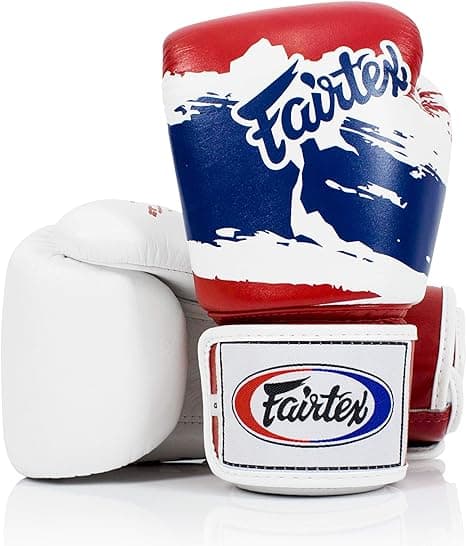
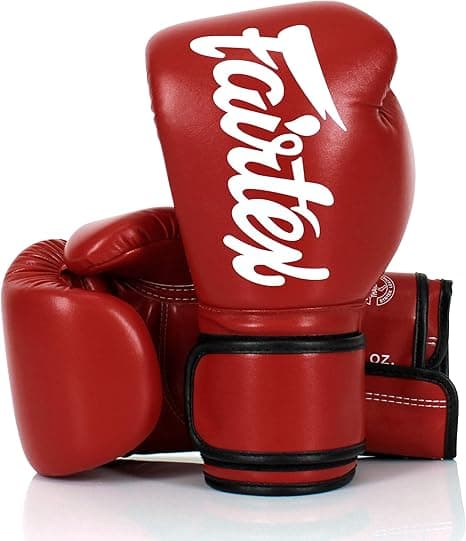
Fairtex BGV1 Muay Thai Boxing WRB
Perfect fit: Fairtex boxing glove 2 pair set is ergonomically designed with a unique contoured and tight-fit hand compartment designed to provide a secure and snug fit makes it easy for men & women Shock Absorbent: The muay thai gloves are constructed of premium leather with Fairtex foam system and pads for excellent hand and knuckle protection & shock disbursement for heavy bags & speed bag
the Muay associated with the court and royal institutions.
Muay Phra Nakhon
the combat practices developed in the capital.
Muay Pala Sueksa
the tradition of Muay institutionalized through physical education.
Southern Muay Traditions
including areas like Nakhon Si Thammarat and Pattani.
Northern Martial Traditions
such as Jeng (เจิง), belonging to the Lanna martial universe and not simply a "Muay school".
These traditions do not all have the same level of documentation. Some are known primarily through 20th-century sources or oral tradition.
This does not make them irrelevant.
On the contrary:
the absence of documentation may precisely be evidence of the fragility of historical transmission.
The mistake would be to fill the documentary silence with an invented history.
The 19th Century: When Regional Differences Begin to Become More Visible
The 19th century is crucial for understanding the transition.
Muay was not yet the standardized national sport we know.
Fights could occur:
at festivals;
at fairs;
at ceremonies;
on temple grounds;
at court-related events;
in communities.
The Thailand Foundation records that traditional competitions could take place in open spaces and that time was controlled very differently from modern rounds, including through the use of a perforated coconut shell placed in water.
Hands were wrapped with:
คาดเชือก — Kaad Chuek
ropes or bands that served as protection and simultaneously profoundly modified the nature of the strikes.
All the structures we now associate with professional Muay did not yet exist.
The court begins to transform regional Muay into national heritage
The transformation accelerates during the reign of:
Rama V — Chulalongkorn
1868–1910.
The king promoted competitions among fighters from different regions of the kingdom. The practice ceased to be merely a local phenomenon and began to function as regional representation before the court.
This process is extremely important.
Because now we have:
region
↓
fighter
↓
competition
↓
court
↓
title
↓
national representation.
The case of Daeng Thaiprasert, Klueng Tosa-at, and Prong Chamnongthong became particularly important in this history.
The regional tradition records Daeng as the representative of Korat, Klueng as the representative of Lopburi, and Prong as the representative of Chaiya.
From then on, the idea that certain fighters embodied certain schools gains strength that will later be fundamental for the construction of Muay historiography.
The Role of Camps and Lineages
One of the biggest differences between ancient Muay and contemporary sport lies in the way knowledge is transmitted.
Today we think in terms of:
academy → coach → student → training program.
In ancient traditions, the logic was closer to:
master → disciple → lineage → community.
The master did not just transmit strikes.
He transmitted:
posture;
ethics;
discipline;
ritual;
secret knowledge;
body preparation;
ways of fighting;
ways of behaving.
The Thailand Foundation itself states that masters carefully selected students and that only those who demonstrated discipline and character received progressive access to combat knowledge.
Therefore, talking about lineage is more appropriate than simply talking about "style".
The main lineages we can trace
Korat
An important sequence of regional memory involves:
Phra Hem Samahan
→ Daeng Thaiprasert
→ various regional disciples and teachers
→ later transmission to Muay Korat schools and teachers.
Regional documentation also records other important names, including Kru Bua, Phuan Kanjanakas, and other 20th-century teachers.
Lopburi
The lineage is less easily reconstructed continuously.
We have:
local masters
→ Klueng Tosa-at
→ regional transmission
→ fragmentary preservation in the 20th century.
This is an excellent example of why we should not force a continuous genealogy when the documentation does not allow it.
Chaiya
It is probably the tradition whose modern continuity has been most clearly preserved.
An important traditional chain passes through:
Poh Than Ma
↓
Phraya Waji Sattayarak / Cha Sriyaphai
↓
Prong Chamnongthong
↓
Kru Khet Sriyaphai
↓
various modern teachers and lineages.
Here we need to distinguish traditional genealogy from documentary proof of each link.
The Chaiya tradition, however, has enough living continuity to be studied directly through contemporary masters.
Tha Sao
The tradition preserved in Uttaradit presents a particularly interesting genealogy:
Kru Mek
↓
Kru Iam
↓
Kru Aim
↓
Kru Aat Kongket
↓
local families and teachers
↓
modern transmission of Tha Sao/Phraya Phichai.
The figure of Phraya Phichai Daap Hak serves as a symbolic link between regional Muay and the warrior culture of the Thonburi period.
What happened to these lineages when Muay became a sport?
Here lies the decisive point.
They did not simply disappear.
They were absorbed.
When Muay began to be regulated, it became necessary for fighters from different regions to compete under the same conditions.
This meant:
same ring
→ same gloves
→ same rounds
→ same rules
→ same technical limitations.
The Thailand Foundation records the transition from traditional forms of combat to modern sport during the process of formalizing the rules, including the replacement of Kaad Chuek with Western gloves.
The Birth of Modern Muay Thai
The transformation occurs mainly between the late 19th century and the early decades of the 20th century.
During the reign of Rama VI, Muay more clearly enters the realm of physical education, and the Suan Kulap Wittayalai School stadium becomes important for the institutionalization of the practice.
Then:
1945
the Ratchadamnoen Stadium emerges.
1950s
professionalization consolidates.
1960s
the Lumpinee Stadium becomes one of the main institutions of the sport.
From then on, the logic of "regional styles" begins to compete with another identity:
the Muay Thai fighter.
It no longer matters if he was born in Korat, Chaiya, or Lopburi.
He needs to master the repertoire necessary to win within the national rules.
The most accurate answer is:
from none of them in isolation.
Modern Muay Thai is the result of the convergence of various traditions.
Korat contributed to a culture of power.
Lopburi preserved a tradition of precision, mobility, and counterattack.
Chaiya maintained a sophisticated culture of posture, defense, control, and Ram Muay.
Tha Sao preserved elements of speed, mobility, and close combat.
Alongside them existed other traditions, some partially documented and others practically lost.
Standardization did not completely erase these differences. It created an environment in which they began to compete, mix, and adapt.
Why is studying these styles still important?
Because when we observe modern Muay Thai, we are looking at the final result of a much larger story.
The contemporary fighter who works:
teep;
roundhouse kick;
elbow;
knee;
clinch;
counterattack;
movement;
is not necessarily practicing "Korat", "Chaiya", or "Lopburi".
He is practicing Muay Thai.
But within this national system survive fragments of ancient traditions.
That is precisely why studying regional styles does not mean trying to turn modern Muay back into four schools.
It means understanding where the technical diversity that modern sport absorbed came from.
Conclusion: Muay Thai is Younger Than Its Memory
Perhaps this is the best way to conclude the discussion.
Muay has ancient roots.
The combat traditions of Siam predate modern sport.
Communities developed different ways of fighting.
Masters transmitted knowledge.
Soldiers utilized these skills.
Temples and festivities served as spaces for transmission and competition.
The court transformed regional fighters into representatives of the kingdom.
Bangkok began to centralize training.
Physical education institutionalized knowledge.
The stadiums created a national competitive environment.
The rules transformed technique.
Gloves replaced Kaad Chuek in the sport.
And Muay became Muay Thai.
But something remained.
The master.
The lineage.
The respect.
The Wai Kru.
The Ram Muay.
The music.
The Mongkhon.
The Prajiad.
And, in certain lineages, an even deeper memory of ritual, magic, protection, and ancestry.
Therefore, it may be more accurate to say that modern Muay Thai did not completely replace the ancient Muay.
It absorbed them.
And the Ram Muay is one of the most visible pieces of evidence of this survival.
Sources and Bibliography for Further Study
Thailand Foundation — Muay Thai. It is one of the best institutional sources in English for an overview of the four regional traditions, historical formation, training, Wai Kru, Mongkhon, and Prajiad. Thailand Foundation — Muay Thai
Department of Physical Education, Ministry of Tourism and Sports — Institute for Conservation of Muay Thai Arts. Thai institutional material presents the five styles of Muay, including Pala Sueksa, and describes regional technical characteristics. Department of Physical Education — Five Styles of Muaythai
Peter Vail — “Muay Thai: Inventing Tradition for a National Symbol”. Sojourn: Journal of Social Issues in Southeast Asia, 29(3), 2014, pp. 509–553. It is fundamental for critically understanding the transformation of Muay into a national symbol and the modern construction of its history. Peter Vail — Muay Thai: Inventing Tradition for a National Symbol
Muay Korat — แม่ไม้มวยโคราช. A project dedicated to the preservation and documentation of the Korat tradition, including masters, fighters, and technical characteristics. Muay Korat — The Martial Arts of Muay Korat
Panya Kraitus — Muay Thai: The Most Distinguished Art of Fighting. A classic reference for the systematization of the technical traditions of Muay.
Pattana Kitiarsa — anthropological studies on Muay Thai, ritual, and Thai popular culture. Important for understanding Muay not just as a sport, but as a social and ritual institution.
Muay Thai Expert — independent editorial. Affiliate links on product pages are disclosed.